Building a pool in Orangeville
Orangeville is the seat of Dufferin County, a town of about 30,000 on rolling countryside an hour northwest of Toronto. It sits on the Orangeville Moraine, a ridge of glacial sand and gravel, an important groundwater recharge area, and the Credit River begins in the headwaters around town. That geography shapes every pool project: fast-draining ground that can still turn wet, a shorter season than the cities down the escarpment, and a permit process centred on the pool enclosure.
Permits and bylaw rules
The Town's [Pool and Hot Tub Permits page](https://www.orangeville.ca/en/doing-business/pool-and-hot-tub-permits.aspx) and [Swimming Pool Enclosure By-law 15-93](https://www.orangeville.ca/Modules/Bylaws/Bylaw/Download/e5b2bb0e-ff58-4d1f-bd56-2135eb080d9e) govern the work, and the by-law is explicit: no one may excavate for, or erect, a privately owned outdoor pool without a pool enclosure permit first (section 4.1).
- Apply on the Town's Building Permit Application at Town Hall, 87 Broadway, or by email. If you are not the registered owner, include a letter of authorization.
- The package needs a survey showing the pool's location and dimensions and its setbacks from the side and rear lot lines, fencing details (type and height), and a grading plan.
- Fees are $184.76 above-ground and $316.73 in-ground, and an in-ground pool carries a minimum $500 damage deposit. Contact the Town before an in-ground install or any grading change.
- Inspections are staged: stake-out before excavation, fencing before any water goes in, and a final inspection before filling. Give at least one business day's notice for each.
- Any pool holding more than 600 mm (24 in) of water needs the enclosure permit — inflatable pools included. A pool cannot go on an easement. A hot tub does not need a building permit, but the enclosure by-law still applies, which in practice means a lockable rigid cover when unused. A pool shed over 161 sq ft needs a permit, and one more than 7 ft at mid-span must keep 4-ft setbacks.
The Town's [pool zoning guide](https://www.orangeville.ca/en/doing-business/resources/Documents/Pools_bifold%20-%202023-03-22%20-%20reduced.pdf) keeps the pool and any access deck at least 1.2 m from a side or rear lot line, and easements can tighten that further. [Zoning By-law 22-90](https://www.orangeville.ca/en/doing-business/resources/Documents/Zoning%20By-law%2022-90%20-%20March%2010%202025%20with%20Maps%20and%20Figures.pdf) s.5.2(2) puts a pool behind the front wall of the house, under 10 percent lot coverage, and its encroachment table allows pumps, filters and heaters as close as 0.6 m to the rear or interior side lot line.
The enclosure is specified in detail. It must stand 1.5 m (5 ft) high for a detached, semi-detached, row or small multiple dwelling, and 1.8 m (6 ft) for everything else, measured on the outside face. A gap of up to 50 mm (2 in) under the fence is allowed, no climbable member may sit between 100 mm and 1.8 m, and the fence must be at least 1.2 m from the pool's inside wetted wall. Gates must self-close and self-latch at the top on the inside, and stay locked when unsupervised. During construction the hole must carry a temporary enclosure — 1.2 m plastic mesh with steel T-bar posts — and no water may be added until the permanent one is up. Lots near the Credit River or a tributary may also fall under [Credit Valley Conservation's regulated area](https://cvc.ca/regulation-mapping/) — check the map before fixing a layout.
Lots, soil and ground conditions
The moraine gives Orangeville mostly sand and gravel: quick to excavate, good drainage, and easier digging than the clay flats or escarpment rock of neighbouring towns. The catch is groundwater. In low ground and near the Credit's headwater streams the water table can sit high enough that a dug hole weeps, and builders here plan dewatering in advance. Boulders in the glacial till turn up on some lots and are priced as extra excavation.
Lot type matters as much as soil. The older grid around Broadway and the downtown has narrow backyards, mature trees and tight side access, so expect a compact machine, a fence panel removed, or a crane over the roof. The newer subdivisions on the town's edges offer cleaner access but compact, builder-graded yards with buried services and little room to stage spoil. Estate and rural-edge lots toward Mono and Amaranth have the space, at the cost of longer machine and haulage runs.
The season
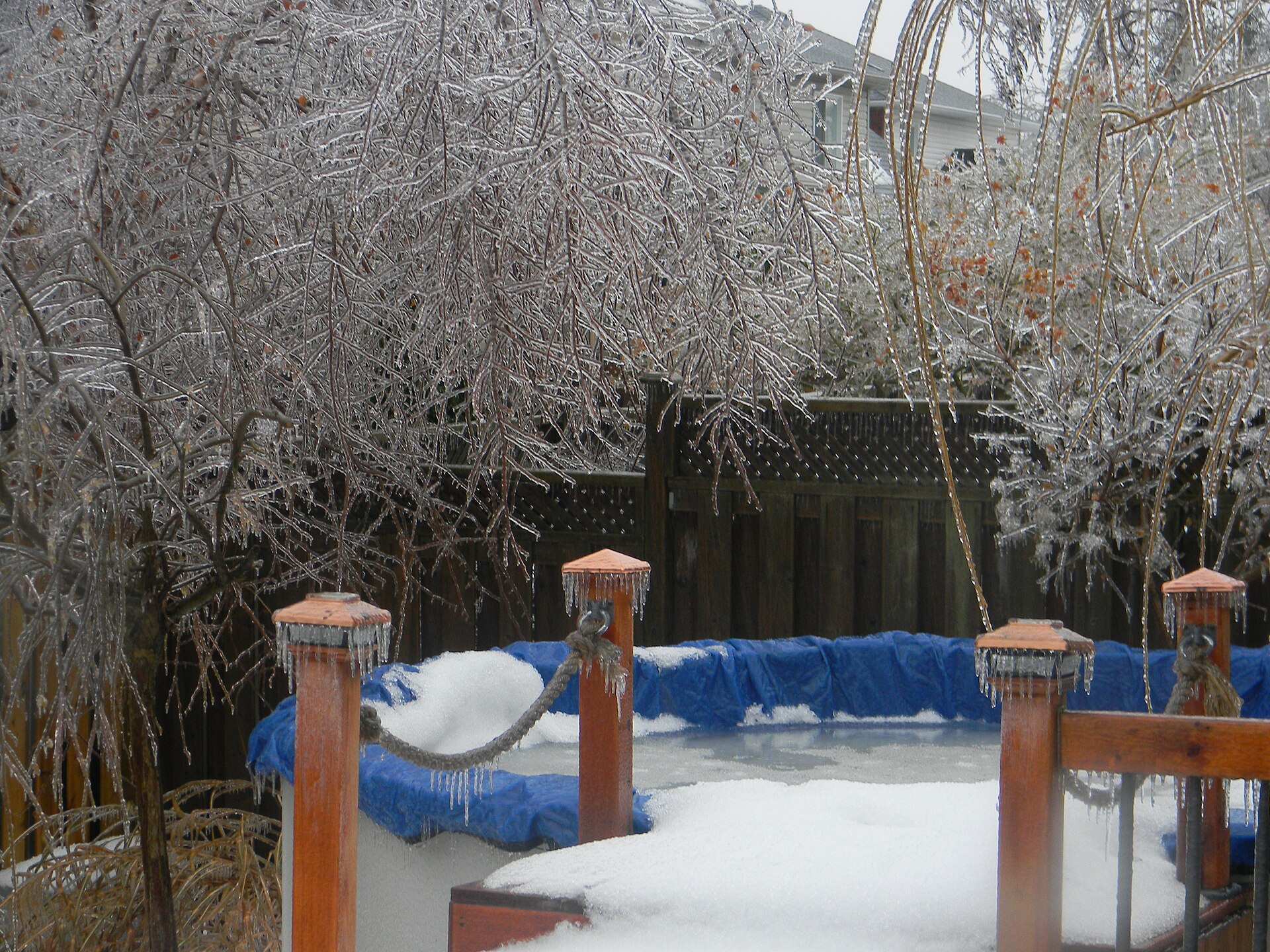
Orangeville's growing season runs from mid-May to early October. Digging starts after the spring thaw, most builds run June to September, and the reliable swim window is late June to Labour Day. Close and winterize before hard freeze: lines blown out, equipment drained, cover secured against snow load. A short, fully booked season is the main reason to line up a builder in winter or early spring.
What drives the price and what to ask
Quotes in Orangeville swing on access into older downtown yards, spoil haulage and dewatering where the water table is high, boulder excavation, the survey and grading plan the permit requires, the mandated fence and self-latching gates, the damage deposit, and electrical and gas runs to the equipment pad — pool wiring needs an Electrical Safety Authority notification, so ask who files it. Scheduling inside a compressed season adds its own premium.
Ask each pool builder:
- Have you pulled Orangeville pool enclosure permits before, and will you prepare the survey, fencing details and grading plan?
- Who books the stake-out, fencing and final inspections, and how is the $500 damage deposit handled?
- What is your dewatering plan if the hole weeps, and how is it charged?
- On my lot, are boulders or shallow groundwater a risk — and what do they add to the price?
- Will the planned pool and deck meet the 1.2 m side and rear setbacks on my lot?
- What fence design and gate hardware do you propose, and does it meet the 1.5 m or 1.8 m height rule and the self-latching requirement?
- What does the written warranty cover — shell, plumbing, liner, workmanship — and for how long, and are opening and closing included in year one?